

Upgrading to heavy-duty, puncture-resistant tires can slightly reduce your e-bike’s per-charge battery range, but the drop is usually far smaller than most riders expect. On average, switching from lightweight stock e-bike tires to premium flat-protected tires results in a 2% to 7% loss in total battery range—typically costing you 1 to 3 miles on a full charge.
However, in many real-world scenarios—especially when moving from soft, low-pressure off-road tires to high-pressure, low-rolling-resistance urban tires like the Schwalbe Marathon E-Plus—your efficiency can actually increase.
Understanding the balance between flat protection and battery efficiency comes down to three physical factors: rotational mass (weight), rolling resistance ($C_{rr}$), and tire pressure (PSI).
The Physics of E-Bike Tire Efficiency
When evaluating how tire upgrades affect your range, you are balancing the energy used by your motor against the forces slowing your bike down.
Total Resistance = Rolling Resistance (Crr) + Aerodynamic Drag + Gradient (Hill) Resistance + Mass Inertia
1. Rotational Mass vs. Static Mass
Adding weight to your tires is twice as impactful on acceleration as adding weight to your frame or panniers. Because tires must rotate and move forward, accelerating heavier tread requires more initial watt-hours from your battery.
- Impact on flat land: Minimal. Once up to cruising speed (e.g., 20 MPH), weight plays almost no role in maintaining speed.
- Impact on stop-and-go commuting: Moderate. Accelerating heavy tires from a complete stop at city lights drains more battery capacity over time.
2. Rolling Resistance Coefficient ($C_{rr}$)
Rolling resistance is the energy lost as the tire rubber continuously deforms and reshapes against the road surface.
- Flexible, highly elastic rubber compounds (like natural rubber belts or silica-infused compounds) rebound quickly, returning energy to the wheel and maintaining low $C_{rr}$.
- Thick, stiff, low-grade rubber or solid airless inserts absorb energy without bouncing back efficiently, forcing the electric motor to pull more amps continuously.
3. Air Pressure (PSI) and Tread Geometry
Riding on soft, under-inflated tires creates a wide contact patch that increases friction. Puncture-resistant tires built with rigid casings allow higher PSI levels without flexing dangerously, reducing drag on smooth asphalt.
Regional Hazard Analysis: Range vs. Reliability
Depending on where you ride, the trade-off between a tiny range loss and absolute flat protection varies based on local hazards and geography.
Texas (Austin, Dallas, Houston)
- Terrain & Hazards: Prickly pear cactus, mesquite thorns, and invasive puncture vine (goatheads).
- Efficiency Factor: Flat road terrain in Houston and Dallas offsets the slight weight increase of thick tire belts. In Austin’s Texas Hill Country, extra rotational weight requires slightly higher assist levels on climbs.
- Verdict: Goathead thorns cause instant flats. Losing 2% of range to install a thick Kevlar or natural rubber belt is a net gain compared to getting stranded in 100°F summer heat.
New York (NYC, Brooklyn, Albany)
- Terrain & Hazards: Broken glass, discarded razor blades, construction staples, pothole rims, and metal expansion joints.
- Efficiency Factor: Constant stop-and-go acceleration at city intersections means heavier tires consume more juice during startup.
- Verdict: Repairing a rear hub-motor flat on a busy NYC avenue is dangerous and time-consuming. Switching to reinforced city tires provides peace of mind while only reducing battery life by roughly 1 to 2 miles per charge.
San Francisco & Bay Area
- Terrain & Hazards: Steep urban grades (15%+ incline), steel cable car tracks, jagged street debris, and coastal moisture.
- Efficiency Factor: On steep SF hills, total weight heavily influences energy consumption. Heavy tires force the motor to work harder against gravity.
- Verdict: Choose lightweight, high-woven-density tires (like Aramid/Kevlar belts) rather than thick, heavy solid rubber liners to keep rotational weight down while climbing.
Southern & Northern California
- Terrain & Hazards: Glass along coastal bike paths (LA/San Diego), hot pavement, choya cacti in desert regions, and long uninterrupted commutes.
- Efficiency Factor: High average speeds (20–28 MPH) mean wind resistance is your primary energy drain. Rotational weight matters far less at steady speeds on coastal paths.
- Verdict: Low rolling resistance casing is key. A fast-rolling tread compound preserves range on long stretches while preventing glass punctures.
Washington State (Seattle, Tacoma, Spokane)
- Terrain & Hazards: Wet road oil, slick tree roots, sharp crushed basalt gravel, and steep maritime hills.
- Efficiency Factor: Rain requires lower tire pressures for traction on slick pavement, slightly increasing rolling resistance.
- Verdict: Puncture protection with sticky rubber compounds (like Schwalbe ADDIX-E) guarantees cornering grip in wet Seattle weather without excessive energy loss.
Top 5 Puncture-Resistant E-Bike Tires Reviewed
Here is how the top-rated puncture-resistant e-bike tires perform regarding flat protection, weight, and battery impact.
1. Schwalbe Marathon E-Plus
- Best For: Heavy-duty city commuting, cargo e-bikes, and speed pedelecs (up to 28 MPH / 50 km/h).
- Puncture Technology: Smart DualGuard (5mm SmartGuard natural rubber + 2 layers of RaceGuard woven fabric).
- Weight: ~1,150g (27.5 x 2.0″)
- Battery Impact: Negligible (-1% to -3%).
- Review: The gold standard for electric bike tires. While heavy, its patented ADDIX-E rubber compound delivers low rolling resistance that offsets its weight on flat or rolling terrain. Puncture protection is virtually impenetrable to glass, tacks, and thorns.
2. Continental Contact Plus E-50
- Best For: Urban commuters and long-distance touring e-bikes.
- Puncture Technology: SafetyPlus Breaker (Flexible rubber combined with woven PolyX fiber).
- Weight: ~1,050g (28 x 2.0″)
- Battery Impact: Minimal (-2% to -4%).
- Review: Designed specifically for fast e-bikes, the SafetyPlus Breaker absorbs sharp object impacts while remaining elastic. Excellent cornering grip on wet surfaces (ideal for Washington riders) and high sidewall load capacity.
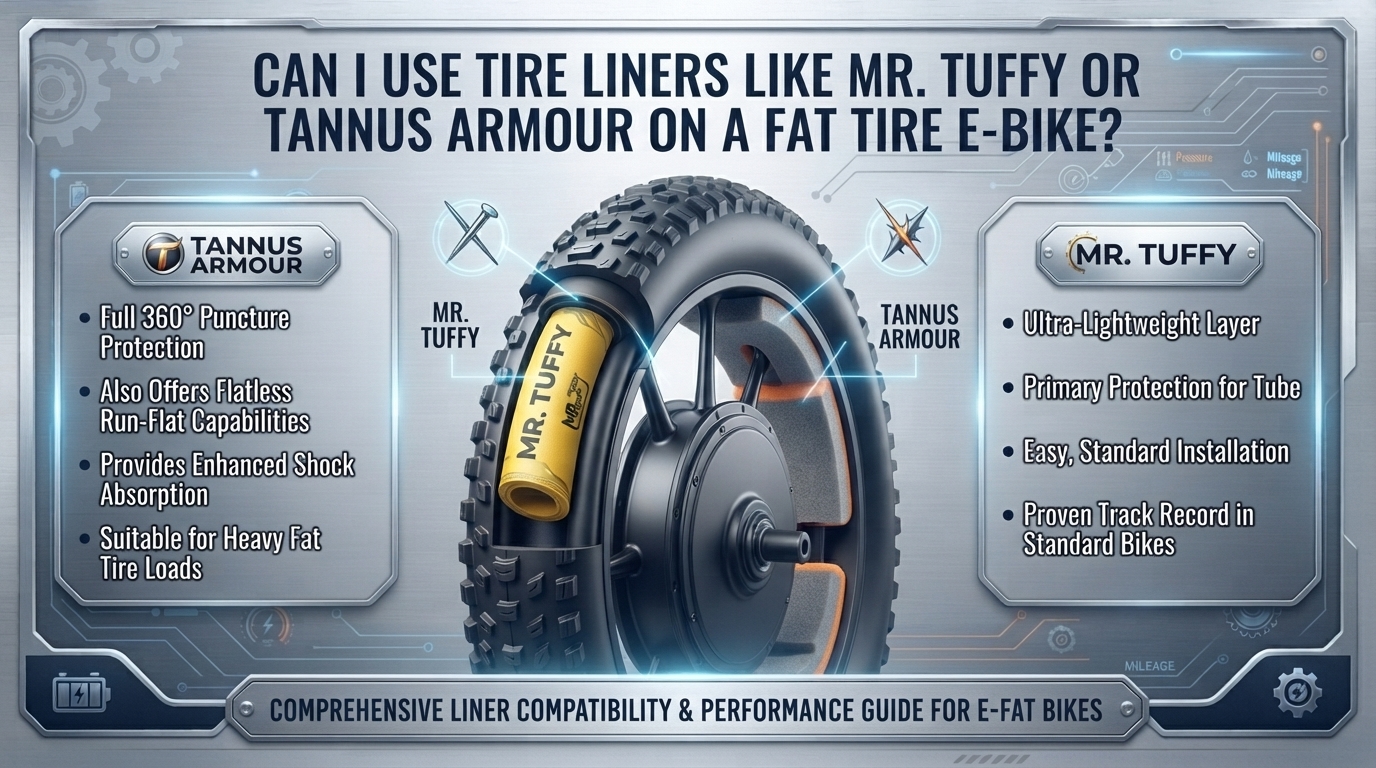
3. Tannus Armour Foam Inserts (Paired with Standard Tires)
- Best For: Ultimate flat immunity without going tubeless, fat tire e-bikes, and extreme thorn areas.
- Puncture Technology: 15mm Aither multi-cell foam core beneath tread, 2–5mm sidewall protection.
- Weight: ~320g–500g insert weight per wheel (plus downsized inner tube).
- Battery Impact: Moderate (-4% to -8%).
- Review: Tannus Armour encases a smaller tube in dense foam. It adds noticeable rotational weight and flex, which slightly reduces range on hilly rides. However, it offers full run-flat capability, allowing you to ride slowly on a flat tube without damaging your wheel rim.
4. Goodyear Transit Speed S3 (Tubeless Complete)
- Best For: Performance riders, long-range commuters, and gravel-commute hybrids.
- Puncture Technology: S3:1 Shell protection layer under slick tread.
- Weight: ~680g (700x40c)
- Battery Impact: Positive (+2% to +5% range gain vs. cheap stock tires).
- Review: When set up tubeless, this tire eliminates the friction of an inner tube entirely. The lightweight supple casing yields low rolling resistance while liquid sealant handles small punctures instantly. Excellent for hilly cities like San Francisco.
5. Maxxis Hookworm / SilkShield
- Best For: Fat tire e-bikes, urban assault, curb hopping, and pavement cruising.
- Puncture Technology: SilkShield bead-to-bead high-density woven protective layer.
- Weight: ~1,300g (26×2.5″)
- Battery Impact: Moderate (-3% to -6%).
- Review: A massive, high-volume tire with a wraparound tread pattern. Its weight can drain extra battery capacity during frequent acceleration, but its high air volume creates a smooth ride over potholes and curb strikes.
Comprehensive E-Bike Tire & System Comparison
| Tire / Protection System | Puncture Defense Level | Added Weight (Per Pair) | Rolling Resistance (Crr) | Estimated Battery Range Impact | Best Terrain / Regional Match |
| Stock Cheap E-Bike Tire | Low (Level 2/7) | Baseline (0g) | High ($C_{rr} \approx 0.012$) | Baseline (0%) | Smooth asphalt, low hazard zones |
| Schwalbe Marathon E-Plus | Outstanding (Level 7/7) | +500g to +800g | Low ($C_{rr} \approx 0.006$) | -1% to -3% (Near neutral) | Glass, urban debris, NYC, TX thorns |
| Continental Contact Plus | Very High (Level 6/7) | +400g to +700g | Low-Moderate ($C_{rr} \approx 0.007$) | -2% to -4% | Wet urban streets, WA, CA coastal |
| Tannus Armour + Tube | Extreme (15mm Foam) | +600g to +1000g | Moderate-High ($C_{rr} \approx 0.010$) | -4% to -8% | Goatheads, TX, desert cacti, run-flat protection |
| Tubeless Conversion + Sealant | Self-Healing (High) | -200g to -400g (Weight Savings) | Lowest ($C_{rr} \approx 0.005$) | +2% to +6% (Range Increase) | SF hills, long CA commutes, WA gravel |
| Solid Airless Rubber Tire | Total Immunity (100%) | +1200g to +2000g | Very High ($C_{rr} \approx 0.018$) | -12% to -20% | Short-distance industrial commuting |
Actionable Tips to Maximize Battery Range with Heavy Tires
If you install puncture-resistant tires or Tannus foam inserts, you can offset any minor battery range drop by following these efficiency tips:
- Maintain Proper Inflation Pressure (PSI): Check your tire pressure weekly. Riding a reinforced tire at 20 PSI when it is rated for 45 PSI doubles its rolling resistance, draining your battery faster than the tire’s weight ever could.
- Opt for Low-Rolling-Resistance Rubber Compounds: Look for e-bike-specific tire certifications (like ECE-R75) that use advanced silica or natural rubber compounds. These materials absorb impacts while bouncing back quickly to save energy.
- Smooth Out Your Acceleration: Instead of using full throttle or highest pedal assist level from a complete stop, start pedaling in a lower gear to reduce the initial electrical amp spike on heavier wheels.
- Consider a Tubeless Setup: Converting your wheels to tubeless eliminates inner tube friction, lowers rolling resistance, and sheds weight.
- Use Liquid Tube Sealant Wisely: Adding 3 to 4 ounces of liquid sealant (such as FlatOut or Slime) directly into your inner tubes provides automatic puncture healing with less added weight than heavy solid liners.
Frequently Asked Questions (FAQ)
1. Does adding puncture-resistant tires drain my e-bike battery faster on hills?
Yes, but slightly. Extra tire weight increases gravity resistance during steep climbs. On steep grades like those in San Francisco or Seattle, heavy tires consume roughly 3% to 5% more energy climbing compared to flat roads.
2. Why do some premium puncture tires actually INCREASE battery range compared to stock tires?
Cheap factory tires often use rigid, low-grade synthetic rubber with high internal friction ($C_{rr}$). High-end options like the Schwalbe Marathon E-Plus feature engineered tread compounds (ADDIX-E) that flex and roll more efficiently, reducing energy loss and offsetting the tire’s extra weight.
3. How much weight do puncture-resistant tires add to an e-bike?
A pair of premium puncture-resistant city tires typically adds 1 to 2 pounds (450g to 900g) of total weight compared to basic thin-walled bicycle tires. On a 55–75 lb e-bike, this represents a negligible fraction of total system weight.
4. Do solid airless tires decrease e-bike range?
Yes, significantly. Solid airless tires lack air cushioning, causing higher rolling resistance and severe friction energy loss. Installing solid tires can reduce battery range by 10% to 20% and create a harsher ride.
5. Are fat tire e-bikes (4.0″ width) affected more by heavy puncture protection?
Yes. Fat tire e-bikes already feature high rotational mass and wider contact patches. Adding heavy foam liners like Tannus Armour to a 20×4.0″ or 26×4.0″ wheel adds up to 2 pounds of rotating mass per wheel, reducing total battery range by about 5% to 8%.
6. Will puncture-resistant tires lower my e-bike’s top speed?
In almost all cases, no. Your motor’s wattage and speed governor determine top speed on flat ground. Heavy tires take a fraction of a second longer to accelerate to top speed, but once rolling, top speed remains unchanged.
7. How often should I check PSI on heavy e-bike tires to preserve range?
Check tire pressure once every 7 to 10 days. Heavy e-bike tires maintain structural shape even when low on air, making them look inflated when under-pressurized. Riding on low pressure increases rolling resistance and drains your battery faster.
8. What is the difference between Kevlar belts and heavy rubber belts for range?
Kevlar (Aramid) belts are thin, light, and flexible, offering protection against direct punctures with almost zero weight penalty. Thick rubber belts (like Schwalbe’s SmartGuard) add more weight but provide deeper physical clearance against longer nails and glass shards.
9. Is converting to tubeless better for battery range than using thick puncture tires?
Yes. A tubeless setup removes the inner tube, reducing friction and rotational weight. This improves efficiency, potentially increasing range by 2% to 5% while liquid sealant handles small punctures automatically.
10. Is the range loss worth upgrading to puncture-resistant tires?
Absolutely. A minor 2% to 5% reduction in range equals losing about 1 to 2 miles on a 30-mile ride. Avoiding roadside tire repairs—especially on rear hub-motor wheels with heavy cables and brake rotors—far outweigh a negligible decrease in battery distance.
Conclusion
Upgrading to high-quality puncture-resistant tires is one of the smartest investments you can make for your e-bike. While heavy tire casings and protective foam inserts do add rotational mass, the impact on your battery range is minimal—typically costing only a couple of miles per charge.
By choosing tires with low rolling resistance compounds, maintaining proper inflation pressure, and selecting the right setup for your local terrain, you can enjoy flat-free riding without sacrificing performance.