

If you have recently switched from a standard bicycle to an electric bike, you may have noticed an unwelcome trend: e-bikes get flat tires far more often than traditional pedal bikes.
The primary reason is physics. E-bikes carry double to triple the total mass of traditional bicycles, maintain higher sustained cruising speeds ($20\text{–}28\text{ mph}$), and deliver instant electric motor torque directly to the rear wheel. This combination dramatically increases impact forces, causes frequent pinch flats, accelerates tire wear, and forces sharp road debris through rubber treads.
Whether you are navigating the thorn beds of Texas, dodging broken glass and potholes in New York City, negotiating steep grade hills and cable car tracks in San Francisco and California, or riding over wet, slate-filled trails in Washington State, understanding why e-bike tires fail—and how to stop it—is critical for an uninterrupted ride.
1. The Physics of E-Bike Flats: Mass, Velocity, and Torque
To understand why electric bicycles suffer flats at a rate nearly 3x higher than traditional bicycles, we have to look at the structural forces acting on the tire contact patch.
+----------------------------------------------------------------------------------+
|                            PHYSICS OF TIRE DEGRADATION                           |
+----------------------------------------------------------------------------------+
| ELECTRIC BICYCLE (Class 1, 2 & 3)             STANDARD PEDAL BICYCLE             |
| • Mass: 50 – 85+ lbs (Vehicle alone)          • Mass: 20 – 30 lbs (Vehicle alone) |
| • Average Speed: 20 – 28 mph                  • Average Speed: 12 – 15 mph       |
| • Force Distribution: ~70% Rear Wheel Bias    • Force Distribution: ~55% Rear Bias|
| • Kinetic Energy: High (3x Impact Energy)     • Kinetic Energy: Low/Moderate     |
| • Propulsion: Instant Motor Torque (80+ Nm)   • Propulsion: Gradual Human Power  |
+----------------------------------------------------------------------------------+
1. Excess Vehicle Mass
A standard road or hybrid bicycle weighs between 20 and 32 lbs. In contrast, an electric commuter or utility bike weighs 50 to 85+ lbs due to the battery pack, hub or mid-drive motor, controller, and heavy-duty alloy frame.
When you combine a 65 lb e-bike with a 180 lb rider and 15 lbs of cargo, the total payload reaches 260 lbs. Every square inch of the tire’s air chamber experiences immense static pressure. When that heavy tire encounters an obstacle, the internal tube compresses down to the rim far more aggressively than on a lightweight pedal bike.
2. Kinetic Energy ($E_k$) and Impact Force
Kinetic energy increases exponentially with speed ($E_k = \frac{1}{2}m v^2$). Because velocity is squared, riding an e-bike at a sustained 24 mph generates four times the kinetic energy of a standard bicycle rolling at 12 mph at the exact same total weight.
When your tire strikes a jagged pothole edge, curb lip, or sharp stone at 25 mph, that massive kinetic energy is transferred directly into the rubber casing. Debris that would simply bounce off a slow-moving pedal bike tire is forced deep into the tire tread on an e-bike.
3. Motor Torque and Instant Shear Stress
Electric bike motors—especially rear-hub motors generating 60 to 95 Nm of torque—deliver rotational power to the wheel instantaneously. Every time you accelerate from a stop light or push up a hill, the motor tries to spin the rim inside the tire casing.
This creates intense micro-slippage and rotational shear stress on the rubber. Over time, this constant mechanical stress weakens the nylon threads in the tire carcass, making the rubber far more permeable to sharp objects.
4. Severe Rear-Wheel Weight Bias
Most popular consumer e-bikes utilize a rear-hub motor paired with a frame-mounted battery. This places 65% to 75% of the total system weight directly over the rear wheel. Consequently, rear tires on e-bikes suffer roughly 80% of all flat tires, while front tires experience far fewer issues.
2. The 4 Most Common Types of E-Bike Flat Tires
Understanding how your tire is losing air helps you implement the correct preventive solution.
+----------------------------------------------------------------------------------+
|                           THE 4 MAIN FLAT TIRE MECHANISMS                        |
+----------------------------------------------------------------------------------+
| 1. PINCH FLATS ("Snake Bites")  --> Low PSI + High Weight = Tube crushed on rim. |
| 2. PENETRATION PUNCTURES       --> Glass, nails, thorns forced through tread.    |
| 3. VALVE STEM SHEARING          --> Low PSI + Motor Torque = Inner tube slips.     |
| 4. SIDEWALL SLASHES & SCRAPES   --> Scrapes against curbs, rocks, or rail tracks. |
+----------------------------------------------------------------------------------+
1. Pinch Flats (Snake Bites)
Pinch flats occur when the tire compresses completely upon hitting a bump, crushing the rubber inner tube between the hard ground object and the aluminum rim bed. This leaves two distinct parallel slits in the tube that look like a snake bite. Pinch flats are the #1 cause of flat tires on e-bikes, driven directly by low tire pressure and heavy vehicle weight.
2. Penetration Punctures
Penetration flats happen when an object—such as a goathead thorn, carpet tack, broken glass splinter, or steel tire wire dropped from truck tires—pierces directly through the tread carcass and into the air chamber. The higher speeds of e-bikes force these items through rubber much faster than on acoustic bikes.
3. Valve Stem Shearing
Because e-bikes generate powerful rotational torque, running your tires at low PSI can cause the tire outer shell to slip slightly along the rim during heavy acceleration or braking. When the tire slips, it drags the inner tube with it while the valve stem remains locked inside the rim hole. This tears the metal valve stem away from the rubber tube, causing instant air loss.
4. Sidewall Slashes and Rim Pinch Cuts
E-bikes are frequently ridden in urban bike lanes and off-road trails where curbs, sharp rocks, and steel rails sit at foot-level. Because e-bikes carry momentum through turns, glancing blows against obstacles can slice open the thinner rubber wall on the side of the tire casing.
3. Comprehensive Feature Comparison: E-Bike Tires vs. Standard Bike Tires
| Technical Parameter | Standard Pedal Bike | Electric Bicycle (Class 1–3) | Impact on Flat Frequency |
| System Weight (Bike + Rider) | $170 – 200\text{ lbs}$ | $240 – 310+\text{ lbs}$ | High load increases pinch flats by 250%. |
| Cruising Velocity | $10 – 15\text{ mph}$ | $20 – 28\text{ mph}$ | Higher velocity increases puncture force dramatically. |
| Rotational Torque | Smooth human torque ($20-40\text{ Nm}$) | Motor torque ($50-95\text{ Nm}$) | Higher torque tears tire casing and slips inner tubes. |
| Factory Tire Quality | Lightweight 120 TPI casing | Heavy 30–60 TPI rigid rubber | Budget stock e-bike rubber lacks dense puncture belts. |
| Tire Air Loss Rate | $0.5 – 1\text{ PSI / week}$ | $1.5 – 2.5\text{ PSI / week}$ | Heavier static loads accelerate natural seepage. |
| Road Hazard Impact Force | Baseline ($1\text{x}$) | High ($3.5\text{x} – 4.5\text{x}$) | Sharp objects pierce rubber much deeper. |
| Rear Tire Wear Rate | $3,000 – 5,000\text{ miles}$ | $1,000 – 2,500\text{ miles}$ | Thinner tread rubber exposes inner tubes faster. |
4. Regional Puncture Hazards: State-by-State Analysis
Where you ride determines what kind of hazards threaten your tires. Here is how geographic factors impact e-bike tire health across top markets:
                  U.S. REGIONAL HAZARD PROFILE MAP
===================================================================
[ Washington / Pacific NW ]  --> Slate Gravel, Wet Moss, Deep Mud
[ San Francisco Bay Area ]   --> Steep Hill Brakes, Cable Tracks
[ Southern California ]      --> Cactus Needles, Extreme Surface Heat
[ Texas Metropolitan ]       --> Goathead Thorns, Coarse Chip-Seal
[ New York Metropolitan ]    --> Freeze-Thaw Potholes, Glass, Steel Wire
===================================================================
Texas: Goathead Thorns and Extreme Surface Heat
- Primary Threat: Tribulus terrestris (Goathead thorns), sticker burrs, and extreme road heat.
- Why E-Bikes Suffer Here: Texas summers regularly push asphalt temperatures past 130°F (54°C). Hot asphalt softens rubber treads, allowing dried goathead thorns on road shoulders and trails to pierce through easily.
- Best Defense: High-viscosity Kevlar tube sealants (e.g., FlatOut) or converting to heavy-duty tubeless setups.
New York City & Tri-State Area: Construction Debris & Potholes
- Primary Threat: Steel belt fragments from blown car tires, broken glass in bike lanes, and sharp pothole edges.
- Why E-Bikes Suffer Here: NYC commuters ride heavily loaded Class 2 and Class 3 e-bikes at 20+ mph over broken pavement. Hitting a sharp asphalt lip causes immediate pinch flats.
- Best Defense: E-50 rated heavy-duty tires (like the Schwalbe Marathon E-Plus) with 5mm internal rubber breaker shields.
California & San Francisco Bay Area: Steep Grades & Rail Tracks
- Primary Threat: Cable car tracks, steep descents, curb strikes, and glass debris in lane gutters.
- Why E-Bikes Suffer Here: San Francisco’s extreme hills require hard rear-brake deceleration, generating friction heat that wears down rear treads rapidly. Additionally, crossing steel Muni tracks at an angle can trap tire sidewalls and cause pinch cuts or rim strikes.
- Best Defense: Running wider rim setups ($2.2\text{-inch}$ to $4.0\text{-inch}$) paired with tire inserts like Tannus Armour.
Washington State & Pacific Northwest: Wet Slate and Tree Roots
- Primary Threat: Wet slate rock, exposed tree roots, hidden gravel, and damp road debris.
- Why E-Bikes Suffer Here: Moisture acts as a lubricant for sharp objects. A wet piece of glass or sharp rock cuts through rubber much more easily when wet than when dry.
- Best Defense: Silica-infused wet-grip tread rubber combined with proper weekly pressure checks.
5. Top 4 Puncture-Proof Products Tested & Reviewed
Upgrading your tire defense system is the single most effective investment you can make for your e-bike. Here are four top-rated options tested for heavy electric bicycles:
1. Schwalbe Marathon E-Plus Tire
- Best For: Ultimate Urban Commuting & Commercial Delivery
- Puncture Rating: 9.9/10
- Key Feature: 5mm SmartGuard natural rubber sub-tread protection belt.
- Overview: The gold standard for electric bike tires. Certified for high-speed e-bikes (E-50), this tire features an anti-aging sidewall design and a thick center tread layer that stops thumb tacks, glass, and nails dead in their tracks.
- Pros: Unmatched puncture protection; high mileage lifespan ($4,000+\text{ miles}$).
- Cons: Rigid tire bead makes initial hand installation stiff.
2. Tannus Armour Tire Insert
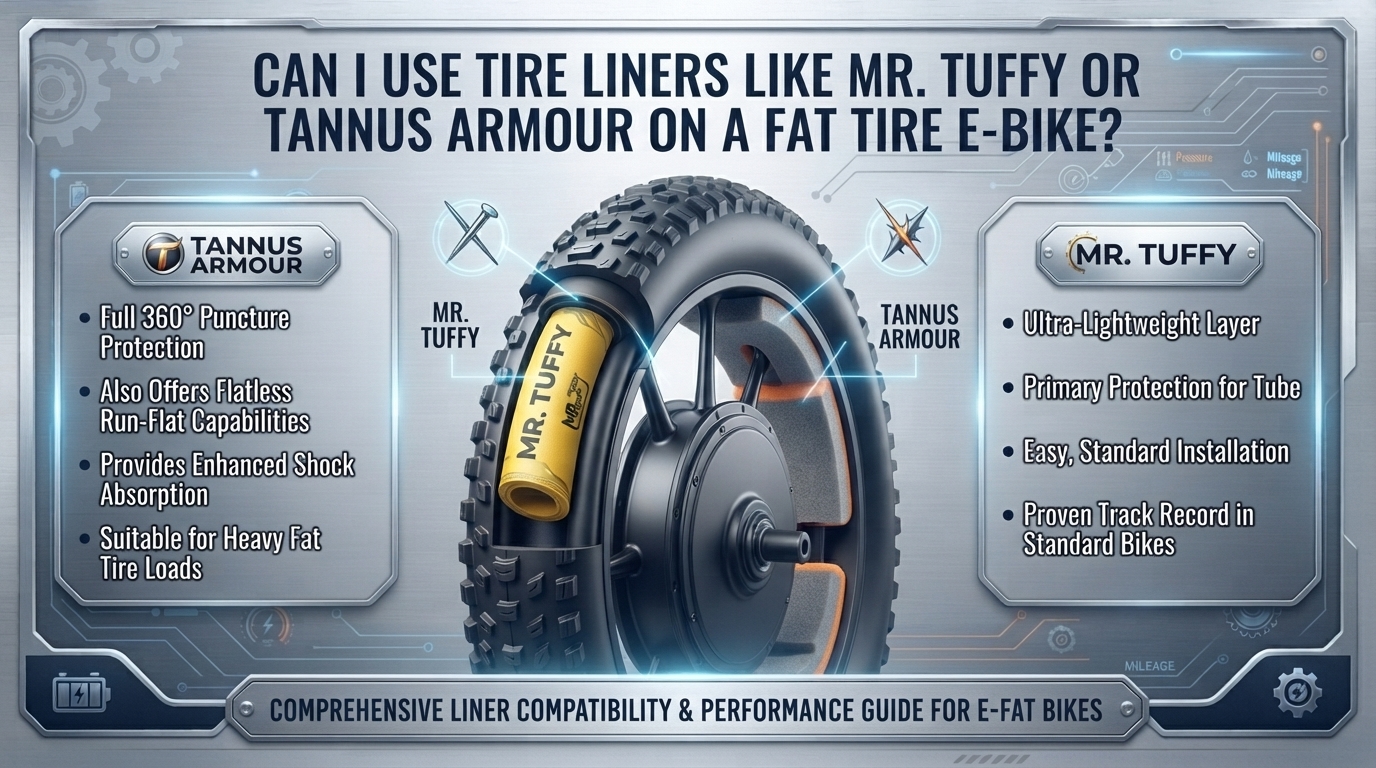
- Best For: Heavy Fat Tire E-Bikes & Tube Protection
- Puncture Rating: 9.6/10
- Key Feature: 15mm thick micro-cell polymer foam shield beneath the tread.
- Overview: Sits inside your tire between the inner tube and the rubber carcass. Tannus Armour acts as a thick foam cushion that prevents sharp thorns or nails from reaching the air tube. It also provides run-flat support if air loss ever occurs.
- Pros: Completely eliminates pinch flats; enables run-flat capability home.
- Cons: Adds $300\text{–}480\text{ grams}$ of weight per wheel.
3. FlatOut Multi-Purpose Sports Formula Tube Sealant
- Best For: Budget-Friendly Protection for Stock Tubes
- Puncture Rating: 9.1/10
- Key Feature: Synthetic liquid formula infused with Kevlar fibers.
- Overview: Injected directly into the inner tube via the valve stem. When a puncture occurs, air pressure forces the fiber-rich sealant into the hole, instantly plugging leaks up to $1/4\text{-inch}$ in diameter.
- Pros: Inexpensive; seals multiple punctures dynamically while riding.
- Cons: Requires a removable valve core for easy installation.
4. Continental Contact Plus City E-50 Tire
- Best For: Potholes & Rough Asphalt Commuting
- Puncture Rating: 9.4/10
- Key Feature: Flexible SafetyPlus rubber-grain breaker layer.
- Overview: Purpose-built for heavy urban loads and fast Class 3 e-bikes. Its dense puncture layer flexes over sharp debris while absorbing high-speed impacts from potholes and concrete seams.
- Pros: Excellent cornering traction in wet conditions; low rolling resistance.
- Cons: Slightly heavier than standard road bike tires.
6. Pro-Grade Flat Prevention Blueprint for E-Bike Riders
To reduce flat tire occurrences by up to 95%, follow this four-step defense plan:
                     4-STEP E-BIKE FLAT PREVENTION BLUEPRINT
+-------------------------------------------------------------------------+
| STEP 1: Maintain High PSI (Check Weekly using a Digital Gauge)          |
| STEP 2: Upgrade to E-50 Rated Tires with Built-In Breaker Belts         |
| STEP 3: Add Fiber Sealant or Tannus Foam Inserts inside Inner Tubes     |
| STEP 4: Adopt Line-Choice Awareness (Avoid Road Gutter Debris)          |
+-------------------------------------------------------------------------+
Step 1: Pump to Upper Recommended Pressure Weekly
Check your tire pressure every single week. Because e-bikes carry extra mass, running lower tire pressure squashes the inner tube down onto the metal rim, causing instant pinch flats. Inflate your tires to the upper 20% of the PSI range printed on the sidewall.
Step 2: Avoid the “Gutter Debris Trap”
Road gutters and the far-right edge of shoulder lanes collect broken glass, steel belt wires, and construction nails swept off the road by passing traffic. Ride $1\text{–}2\text{ feet}$ further inside the clean bike lane or traffic lane where car tires keep the pavement swept clean.
Step 3: Use Heavy-Duty TPU or Thorn-Resistant Inner Tubes
Standard factory inner tubes have thin walls ($0.8\text{ mm}$ thickness). Replace them with 2.0 mm thick thorn-resistant butyl tubes or ultra-dense TPU (Thermoplastic Polyurethane) inner tubes that resist tears and punctures.
Step 4: Install a Dual Defense System (Inserts + Sealant)
For maximum flat protection, combine physical armor with liquid sealant:
- Install a Tannus Armour foam insert inside the tire carcass.
- Add 4 to 6 oz of Kevlar tire sealant inside the inner tube.This double layer stops penetration, eliminates pinch flats, and automatically seals minor thorn holes.
7. Frequently Asked Questions (FAQs)
1. Why does my rear e-bike tire get flat so much more often than the front tire?
The rear tire carries 65% to 75% of the total bike weight due to motor placement, battery positioning, and rider weight bias. Additionally, the rear tire receives direct motor torque, causing faster tread wear and higher impact pressure when rolling over debris.
2. Can I use regular standard bike tubes in my electric bike?
Yes, but standard thin tubes will fail much faster under an e-bike’s weight and torque. It is far better to use heavy-duty thorn-resistant tubes, TPU tubes, or tubes pre-injected with Kevlar tire sealant.
3. How often should I check my e-bike tire pressure?
You should check your e-bike tire pressure at least once a week. E-bike tires naturally lose 1 to 2.5 PSI every week due to high static weight and rubber permeability. Riding even 5 PSI too low dramatically increases your risk of a pinch flat.
4. Are fat tire e-bikes less likely to get flat tires than commuter e-bikes?
Not necessarily. While fat tires ($4.0\text{–}4.8\text{ inches}$) run at low PSI and rarely get pinch flats, their huge surface contact patch sweeps over a wider area of trail, picking up more thorns, nails, and glass.
5. What PSI should I run my e-bike tires at to avoid flat tires?
Run your tires in the top 15–20% of the PSI range listed on your tire’s sidewall. For standard commuter e-bikes ($27.5\times2.0$), this usually means $45\text{–}55\text{ PSI}$. For fat tire e-bikes ($20\times4.0$), aim for $15\text{–}20\text{ PSI}$ on paved roads.
6. Will converting my e-bike to tubeless stop all flat tires?
Tubeless setups eliminate inner tube pinch flats entirely and seal small thorn punctures automatically. However, setting up tubeless on wide e-bike rims requires specialized rim tape, high-volume pumps, and regular sealant top-offs every 3–6 months.
7. Why is fixing a flat on a rear-hub motor e-bike so difficult?
Rear-hub motor wheels are connected to heavy power cables, cutouts, torque washers, and heavy axle bolts. Removing the wheel on the side of the road requires special tools and mechanical effort, making flat prevention far better than roadside repair.
8. Does motor assistance level affect how fast my tires wear down?
Yes. Riding continuously in highest assist or Throttle mode dumps maximum electric current and torque into the rear wheel, slipping the rubber against the road and accelerating tread wear.
9. What are the best flat-proof tires available for e-bikes?
The Schwalbe Marathon E-Plus and Continental Contact Plus City are widely recognized as the top flat-resistant commuter e-bike tires on the market. Both carry an E-50 rating for electric bikes.
10. Does adding tire inserts or heavy tires hurt my e-bike battery range?
Adding heavy puncture-proof tires or foam inserts adds rotational mass, which can decrease total battery range slightly (around 2% to 4%). However, avoiding stranded roadside repairs makes the slight range trade-off well worth it.
Conclusion
E-bikes suffer flat tires more frequently than traditional pedal bikes due to simple physics: greater weight, higher cruising speeds, severe rear-wheel bias, and instant motor torque.
While stock factory tires often succumb to these heavy forces, you do not have to settle for frequent flats. By upgrading to E-50 rated puncture-resistant tires, installing foam inserts like Tannus Armour, using Kevlar tire sealants, and maintaining proper weekly air pressure, you can virtually eliminate flat tires and keep your e-bike rolling smoothly on every commute.